
RF Isolators & Circulators

RF isolators and circulators are passive, non-reciprocal ferrite devices that control the direction of signal flow in microwave systems. Unlike standard passive components, they do not behave the same way in both directions. That non-reciprocal property is exactly what makes them useful: signals pass from one port to the next with low insertion loss in the forward direction, while signals traveling in reverse are suppressed by 17 dB or more.
A

High Isolation and High Power Handling with Solid Build Construction

A

Custom Designs Available

A

Many In-Stock Models and Ready to Ship
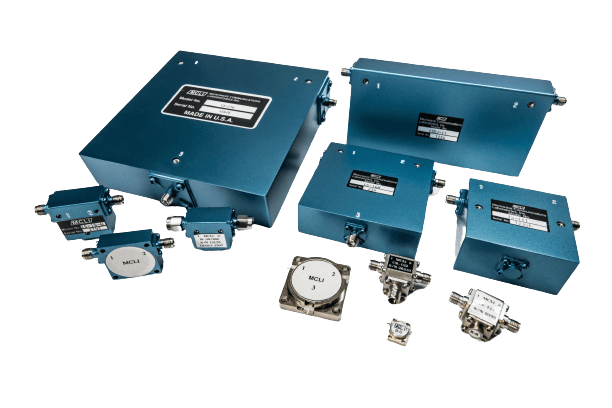
Both devices rely on the gyromagnetic properties of ferrite material. When magnetized by a permanent magnet, the ferrite interacts with incoming microwave signals in a way that depends on the direction of propagation. Signals traveling with the magnetic bias move through with minimal attenuation. Signals traveling against it are blocked. This is how a ferrite circulator routes signals from port 1 to port 2 to port 3 in sequence, and how a ferrite isolator, which is a circulator with its third port terminated in a matched load, becomes a two-port device that passes signals in only one direction.

MCLI offers RF isolators and circulators spanning 380 MHz to 40 GHz in drop-in, coaxial, surface-mount, and waveguide configurations. All models are available in inventory and can be shipped same day. Custom mechanical, electrical, and environmental configurations are available through MCLI engineering.

Browse by Category

Browse all RF Isolators & Circulators

Filters


Connector Series

Frequency Min Range (GHz)

Frequency Max Range (GHz)

Insertion Loss

Isolation (dB)

VSWR In/Out

Power Avg

Flange

Reverse Isolation

VSWR Max

Power Forward (W)

Power Reverse (W)

Operating Temp (C)

Showing 201–300 of 1220 results

Part #ConnectorFrequency Range (GHz)Insertion Loss (dB)Isolation (dB)VSWR In/OutPower Avg. (W)Lead TimeNotesAction
 Min  Max 
IS-111 SMA Female0.650.850.5181.35:11004-5 WeeksN/A Request Quote
CS-59-20 SMA Female0.6950.7050.3201.20:1504-5 WeeksN/A Request Quote
IS-59-20 N Male0.6950.7050.3201.20:1204-5 WeeksN/A Request Quote
CS-112 SMA Female0.710.95151.55:11004-5 WeeksN/A Request Quote
CS-128 SMA Female0.71.40.5181.30:1104-5 WeeksN/A Request Quote
CS-201 SMA Female0.72.71.9101.92:1504-5 WeeksN/A Request Quote
CS-202 SMA Female0.721131.60:1104-5 WeeksN/A Request Quote
CSDJ-3 SMA Female0.70.80.8401.25:12004-5 WeeksN/A Request Quote
CSJ-31 N Female0.70.8031401.20:1504-5 WeeksN/A Request Quote
IS-112 SMA Female0.710.95151.55:11004-5 WeeksN/A Request Quote
IS-128 SMA Female0.71.40.5181.30:1104-5 WeeksN/A Request Quote
IS-202 SMA Female0.721131.60:1104-5 WeeksN/A Request Quote
IS-201 SMA Female0.72.71.9102.10:1508-9 WeeksN/A Request Quote
ISDJ-3 SMA Female0.70.80.7401.25:104-5 WeeksN/A Request Quote
ISDJ-15 SMA Female0.71.41361.30:104-5 WeeksN/A Request Quote
CS-167 SMA Female0.72810.5191.30:11004-5 WeeksN/A Request Quote
IS-167 SMA Female0.72810.5191.30:11004-5 WeeksN/A Request Quote
CS-113 SMA Female0.760.960.5191.30:11004-5 WeeksN/A Request Quote
IS-113 SMA Female0.760.960.5191.30:11004-5 WeeksN/A Request Quote
CS-114 SMA Female0.7630.860.35201.22:11004-5 WeeksN/A Request Quote
IS-114 SMA Female0.7630.860.35201.22:11004-5 WeeksN/A Request Quote
CSJ-38 N Female0.7640.870.8401.25:1504-5 WeeksN/A Request Quote
CSL-31 SMA Female0.7640.870.5201.20:11004-5 WeeksN/A Request Quote
ISL-43 SMA Female0.780.820.5201.20:150/104-5 WeeksN/A Request Quote
CS-115 SMA Female0.790.880.4201.25:1654-5 WeeksN/A Request Quote
MC-47 Tab0.790.860.5181.30:11004-5 WeeksN/A Request Quote
MC-51 Tab0.790.860.5181.30:11004-5 WeeksN/A Request Quote
IS-115 SMA Female0.790.880.4201.25:1654-5 WeeksN/A Request Quote
DI-47 Tab0.790.860.5181.30:104-5 WeeksN/A Request Quote
DI-51 Tab0.790.860.5181.30:104-5 WeeksN/A Request Quote
CS-40 SMA Female0.80.960.4201.25:1504-5 WeeksN/A Request Quote
CS-46 SMA Female0.810.6171.35:1254-5 WeeksN/A Request Quote
CS-62 SMA Female0.810.4201.25:114-5 WeeksN/A Request Quote
CS-69 SMA Female0.82.51121.70:1504-5 WeeksN/A Request Quote
CS-70 SMA Female0.82.20.9121.70:1504-5 WeeksN/A Request Quote
CS-130 SMA Female0.82.51121.70:1254-5 WeeksN/A Request Quote
CS-139 SMA Female0.820.8171.35:1304-5 WeeksN/A Request Quote
CS-167/NF N Female0.80.960.4201.25:11004-5 WeeksN/A Request Quote
CS-139-50 SMA Female0.820.95131.58:1504-5 WeeksN/A Request Quote
CS-301 SMA Female0.80.850.5201.25:1504-5 WeeksN/A Request Quote
CSDJ-2 SMA Female0.811401.25:134-5 WeeksN/A Request Quote
CSDJ-4 SMA Female0.80.90.8401.25:11504-5 WeeksN/A Request Quote
IS-40 SMA Female0.80.960.4201.25:1504-5 WeeksN/A Request Quote
IS-46 SMA Female0.810.6171.35:1254-5 WeeksN/A Request Quote
IS-62 SMA Female0.810.4201.25:114-5 WeeksN/A Request Quote
IS-69 SMA Female0.82.51121.70:1504-5 WeeksN/A Request Quote
IS-70 SMA Female0.82.20.5121.70:124-5 WeeksN/A Request Quote
IS-130 SMA Female0.82.51121.70:114-5 WeeksN/A Request Quote
IS-139 SMA Female0.820.8171.35:1304-5 WeeksN/A Request Quote
IS-167/NF N Female0.80.960.4301.15:11004-5 WeeksN/A Request Quote
IS-46-1 SMA Female0.810.4201.25:114-5 WeeksN/A Request Quote
IS-46-10 SMA Female0.810.4201.25:1104-5 WeeksN/A Request Quote
IS-46-15 SMA Female0.810.4201.25:1154-5 WeeksN/A Request Quote
IS-130-15 SMA Female0.82.51121.70:1604-5 WeeksN/A Request Quote
IS-139-50 SMA Female0.820.95131.58:1504-5 WeeksN/A Request Quote
IS-301 SMA Female0.80.850.5201.25:154-5 WeeksN/A Request Quote
IS-351 SMA Female0.80.960.5201.20:1106-8 WeeksN/A Request Quote
ISDJ-4 SMA Female0.80.90.8401.25:104-5 WeeksN/A Request Quote
CS-50 SMA Female0.8151.0150.4201.30:1504-5 WeeksN/A Request Quote
IS-50 SMA Female0.8151.0150.4201.30:1504-5 WeeksN/A Request Quote
MC-112 Tab0.8180.9180.5201.22:1104-5 WeeksN/A Request Quote
DI-112 Tab0.8180.9180.5201.22:104-5 WeeksN/A Request Quote
CS-36 SMA Female0.820.860.3201.22:1254-5 WeeksN/A Request Quote
IS-36 SMA Female0.820.860.3201.22:1254-5 WeeksN/A Request Quote
IS-352 SMA Female0.820.960.5201.20:1106-8 WeeksN/A Request Quote
IS-319 SMA Female0.8250.9150.5201.25:154-5 WeeksN/A Request Quote
ISL-64 SMA Female0.830.950.3211.20:11004-5 WeeksN/A Request Quote
ISL-63 SMA Female0.840.940.5201.20:11004-5 WeeksN/A Request Quote
CS-35 SMA Female0.852.21121.70:1504-5 WeeksN/A Request Quote
CS-41 SMA Female0.852.51121.70:1254-5 WeeksN/A Request Quote
CS-41-15 SMA Female0.852.51121.70:1254-5 WeeksN/A Request Quote
CS-55 SMA Female0.852.21121.70:1504-5 WeeksN/A Request Quote
CS-56 SMA Female0.852.51121.70:1504-5 WeeksN/A Request Quote
CS-41/NF N Female0.852.51121.70:1254-5 WeeksN/A Request Quote
MC-98 Tab0.850.90.4201.25:1504-5 WeeksN/A Request Quote
IS-35 SMA Female0.852.21121.70:114-5 WeeksN/A Request Quote
IS-41 SMA Female0.852.51121.70:114-5 WeeksN/A Request Quote
IS-41-15 SMA Female0.852.51121.70:1604-5 WeeksN/A Request Quote
IS-55 SMA Female0.852.21121.70:1504-5 WeeksN/A Request Quote
IS-41/NF N Female0.852.51121.70:1254-5 WeeksN/A Request Quote
IS-41-16 SMA Female0.852.51121.70:1604-5 WeeksN/A Request Quote
DI-98 Tab0.850.90.4201.25:104-5 WeeksN/A Request Quote
MC-38 Tab0.860.960.5201.25:11004-5 WeeksN/A Request Quote
DI-38 Tab0.860.960.5201.20:104-5 WeeksN/A Request Quote
MC-71 Tab0.8890.9160.4201.20:1104-5 WeeksN/A Request Quote
DI-71 Tab0.8890.9160.4201.20:104-5 WeeksN/A Request Quote
CS-32 SMA Female0.890.910.35201.22:1254-5 WeeksN/A Request Quote
CS-184/NF N Female0.890.950.3201.25:12004-5 WeeksN/A Request Quote
IS-32 SMA Female0.890.910.35201.22:1254-5 WeeksN/A Request Quote
IS-184/NF N Female0.890.950.3201.25:12004-5 WeeksN/A Request Quote
CS-1 SMA Female0.91.70.7171.38:1504-5 WeeksN/A Request Quote
CS-1/NF N Female0.91.70.6171.35:1504-5 WeeksN/A Request Quote
CS-1-1 SMA Female0.91.70.7161.38:114-5 WeeksN/A Request Quote
CS-1-50 SMA Female0.91.70.7161.38:1504-5 WeeksN/A Request Quote
IS-1 SMA Female0.91.70.5171.35:1504-5 WeeksN/A Request Quote
IS-1/NF N Female0.91.70.6171.35:1504-5 WeeksN/A Request Quote
IS-1-1 SMA Female0.91.70.7161.38:114-5 WeeksN/A Request Quote
IS-1-10 SMA Female0.91.70.6171.35:1104-5 WeeksN/A Request Quote
IS-131-1 SMA Female0.91.80.7161.38:104-5 WeeksN/A Request Quote
ISL-53 SMA Female0.90.960.35231.20:150/204-5 WeeksN/A Request Quote

Full Product Line Specifications

Parameter Range / Options
Frequency Range 380 MHz to 40 GHz
Insertion Loss (Forward) As low as 0.3 dB port to port
Isolation (Reverse) Typically 17 dB to 35 dB; dual-junction models offer 40 dB and above
VSWR As low as 1.20:1 on input and output ports
Return Loss Up to 28 dB on select models
Average Power Handling 1 W to 100 W depending on configuration
Operating Temperature -45 degrees C to +85 degrees C on select models
Package Configurations Drop-in, coaxial connectorized, surface-mount, waveguide
Connector Options SMA, Type N, Tab (drop-in), waveguide flange
Characteristic Impedance 50 ohm
Junction Types Single junction, dual junction
Custom Design Available. Contact MCLI engineering for non-standard requirements.

Where MCLI Isolators and Circulators Are Used

Transmitter Output Protection and Reflected Power Suppression

One of the most common applications for an RF isolator is protecting a power amplifier from reflected power caused by a mismatched load. When the output load impedance changes, or when an antenna connection is lost, reflected power travels back toward the amplifier. An isolator placed between the amplifier output and the load absorbs that reflected energy in its internal matched termination rather than letting it reach the amplifier. This is a concern in radar transmitters, base station power amplifiers, and any high-power system where output mismatch conditions are possible.

LNA and Receiver Front-End Protection

In receive chains, a low-noise amplifier (LNA) is one of the most signal-level-sensitive components in the system. A strong interferer, an adjacent transmitter keying up, or an impedance change upstream can send unwanted energy toward the LNA input. Placing an isolator ahead of the LNA presents the amplifier with a consistent 50-ohm source impedance regardless of what happens upstream, protecting the device and keeping noise figure stable.

Radar and Communications Duplexers

A three-port circulator used as a duplexer lets a transmitter and receiver share a single antenna without the transmit signal reaching the receiver input. The transmitter connects to port 1, the antenna to port 2, and the receiver to port 3. Signals from the transmitter pass to the antenna at port 2. Signals received by the antenna pass to the receiver at port 3, not back to the transmitter at port 1. This transmit-receive isolation is what allows simultaneous operation of a transmit chain and a receive chain on a shared antenna, which is a requirement in most radar and two-way radio systems.

Defense and Electronic Warfare Systems

Defense systems routinely specify isolators and circulators in radar front ends, electronic countermeasure (ECM) transmitters, and signal intelligence (SIGINT) receivers. The need for high reverse isolation, wide operating temperature range, and solid mechanical construction in these environments makes ferrite-based MCLI components a natural fit. MCLI’s drop-in and coaxial models cover S-band, C-band, X-band, and Ku-band frequencies used across airborne, ground, and shipboard radar platforms.

Test and Measurement Signal Path Control

In RF test setups, circulators are used to route signals between a DUT, a signal source, and a measurement receiver without cross-contamination between paths. They are also placed between a VNA port and a high-power DUT to protect the analyzer input from reflected power during swept-frequency measurements. The flat insertion loss and predictable return loss of MCLI’s coaxial connectorized models make them practical for calibrated test configurations.

Isolator vs. Circulator: How They Differ and When to Use Each

An RF circulator is a three-port (or four-port) non-reciprocal device. Signals travel from port 1 to port 2, from port 2 to port 3, and from port 3 to port 1. No port other than the next in sequence receives the signal. Any port can be used as the input, and the signal always exits at the next port in the circulation direction.

An RF isolator is a circulator with its third port terminated in a matched 50-ohm load. Terminating that port converts the circulator into a two-port device that passes signals in the forward direction and absorbs signals traveling in reverse. The isolation figure published for an isolator, typically 17 to 35 dB, tells you how much the reverse signal is attenuated before it is absorbed in the internal termination.

Use a circulator when you need to route signals between three functional ports, such as in a duplexer or a reflection amplifier. Use an isolator when you need one-way signal flow with reverse power absorption at a two-port insertion point in the signal chain.

Feature RF Isolator RF Circulator
Number of active ports 2 3 (or 4)
Third port Internally terminated (matched load) Connected to external circuit
Primary function Reverse power protection, one-way signal flow Directional signal routing, duplexing
Typical isolation 17 to 35 dB 17 to 35 dB per junction
Dual-junction option Yes, for 40 dB+ isolation Yes, for 40 dB+ isolation
Common applications Amplifier protection, LNA front-end, receive chains Duplexers, reflection amplifiers, T/R modules

Package Configurations

RF coaxial connectors on satellite ground station telecommunications equipment

Drop-In (MC and CSL Series)

Drop-in circulators and isolators are designed for direct integration onto a PCB or microwave substrate inside a housing. They use tab connections rather than coaxial connectors, which reduces insertion loss at the connection point and makes them well-suited for miniaturized module assemblies. MCLI’s MC series drop-in circulators cover frequencies from 380 MHz up to 40 GHz with operating temperatures from -45 to +85 degrees C on select models.
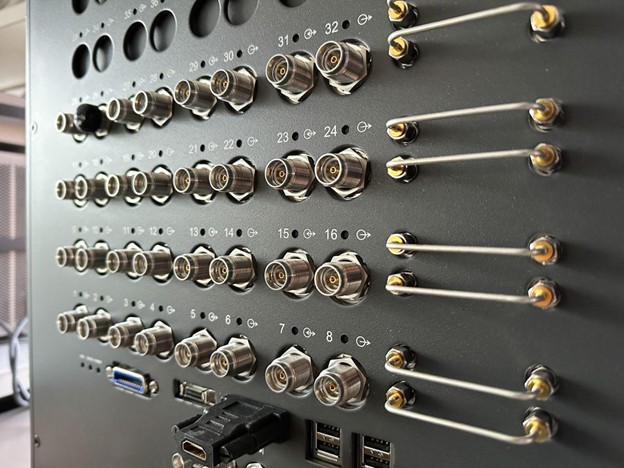
RF parts panel showing multiple coaxial connectors used in high-power medical testing equipment for certified RF systems.

Coaxial Connectorized

Coaxial models use SMA or Type N connectors and are used in benchtop test setups, rack-mounted systems, and anywhere a connectorized in-line component is needed. These are the most common format for lab and test applications. MCLI coaxial isolators and circulators are available across S-band through Ka-band frequencies.
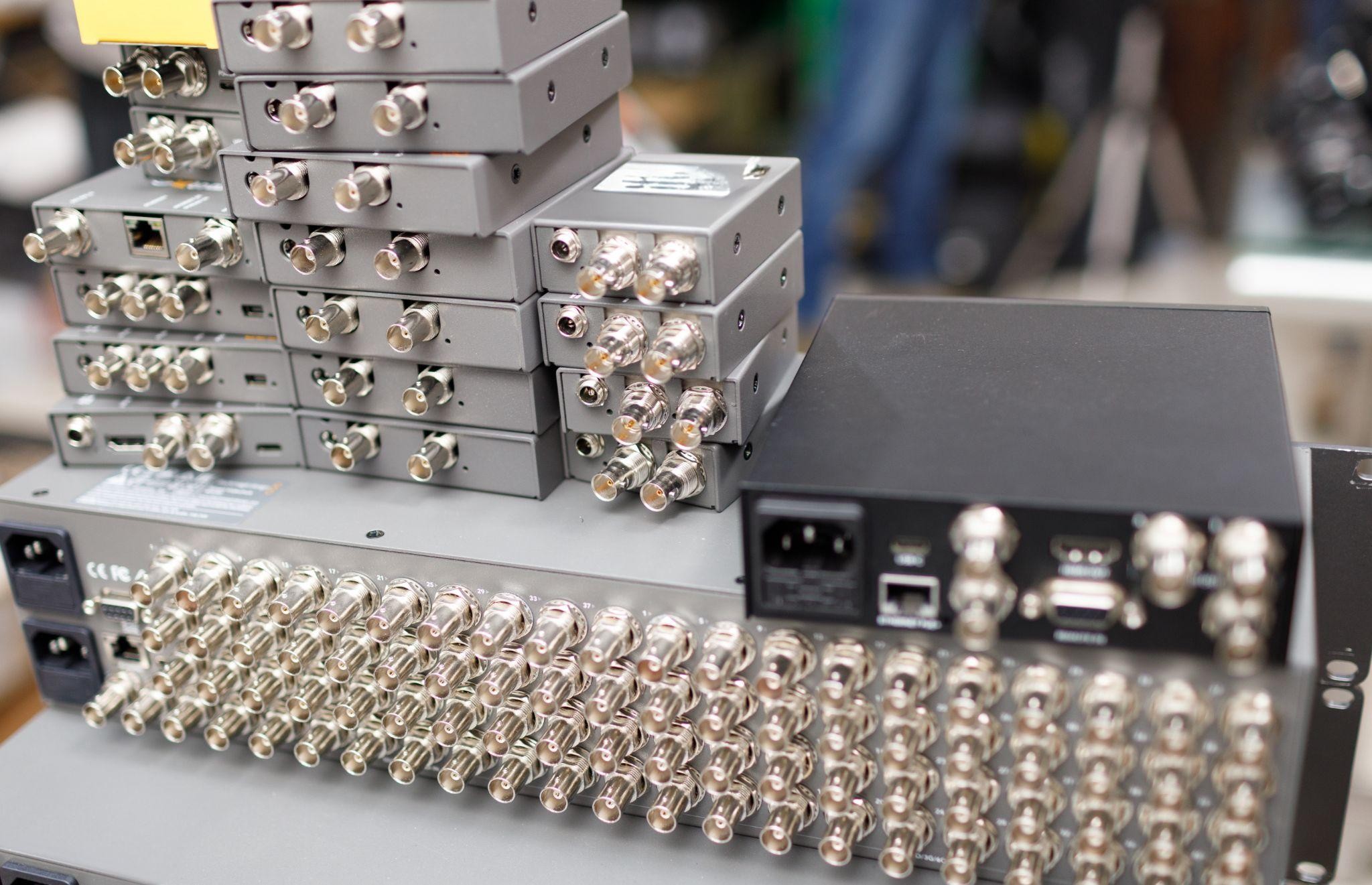
Rack-mounted RF communications equipment with BNC connectors used in defense and broadcast systems

Surface-Mount

Surface-mount configurations allow circulators and isolators to be placed directly on a PCB during board assembly, which is practical in volume production of radio subsystems where board space and assembly cost matter.
Rack-mounted RF communications equipment with BNC connectors used in defense and broadcast systems

Waveguide

Waveguide circulators and isolators are used at millimeter-wave frequencies and in high-power applications where coaxial connectors reach their limits. They offer the lowest insertion loss of any package format and are common in satellite ground systems, high-power radar, and millimeter-wave communications equipment.

Frequently Asked Questions About Circulators and Isolators

What is the difference between an RF isolator and an RF circulator?

A circulator is a three-port non-reciprocal ferrite device that routes signals from each port to the next in sequence. An isolator is a circulator with its third port terminated in an internal matched load, which converts it into a two-port device that passes signals in the forward direction and absorbs signals traveling in reverse. If you need directional signal routing between three active ports, use a circulator. If you need one-way signal flow with reverse power absorption, use an isolator.

How does a ferrite circulator achieve non-reciprocal behavior?

Circulators use the gyromagnetic properties of ferrite material magnetized by a permanent magnet. When a microwave signal enters the ferrite, it interacts with the precessing electron spins in the material. The direction of that interaction depends on the direction of signal propagation relative to the magnetic bias. Signals traveling in the forward direction experience low loss. Signals traveling in the reverse direction are attenuated. This directional difference in signal behavior is what produces the non-reciprocal port-to-port routing that defines a circulator.

What isolation level do I need for amplifier protection?

The required isolation depends on the maximum reflected power your amplifier can tolerate and the worst-case output mismatch you expect. For most solid-state power amplifiers, 20 dB of isolation is a common starting point, which means only 1% of reflected power reaches the amplifier output. In applications where the output mismatch could be severe, such as antenna disconnect conditions, a dual-junction isolator providing 40 dB or more of isolation gives a greater margin. MCLI offers both single-junction and dual-junction isolator configurations.

What is insertion loss in an isolator, and what causes it?

Insertion loss in an isolator is the attenuation from the input port to the output port in the forward direction. It is caused by conductor losses in the stripline or microstrip transmission line, dielectric losses in the ferrite material, and impedance mismatch at the ports. MCLI isolators achieve forward insertion loss as low as 0.3 dB, which is close to the practical minimum for ferrite-based devices. Lower insertion loss in the forward path directly preserves signal power and system noise figure in receive applications.

Can a circulator be used in reverse, with signal entering the port that normally acts as output?

Yes. Because the circulation direction is fixed by the magnetic bias, operating a circulator with signal flow reversed relative to its labeled ports effectively reverses the direction of circulation from the signal’s perspective. The component will route the signal to the previous port in the standard circulation sequence. Insertion loss and isolation performance may differ slightly from the forward specification in this configuration, so confirm with MCLI engineering if your application requires reverse-direction operation.

How does temperature affect isolator and circulator performance?

Ferrite material properties and permanent magnet field strength both vary with temperature, which affects insertion loss, isolation, and center frequency. MCLI specifies operating temperature ranges for each model. Select drop-in and coaxial models are rated from -45 to +85 degrees C and use temperature-compensated magnetic materials to minimize performance drift across that range. For applications outside standard temperature limits, contact MCLI engineering for thermally compensated custom designs.

What is a dual-junction isolator and when should I use one?

A dual-junction isolator connects two circulator junctions in series internally, roughly doubling the reverse isolation to 40 dB or more. Use a dual-junction design when a single-junction isolator’s typical 17 to 25 dB of isolation is not enough, such as in high-power transmitter chains where even a small fraction of reflected power represents significant energy, or in sensitive receive chains where any reverse leakage would raise the system noise floor. MCLI offers dual-junction isolator configurations across multiple frequency bands.

Does MCLI offer custom isolators and circulators for non-standard frequency bands or mechanical requirements?

Yes. MCLI designs custom isolators and circulators for frequency bands, power levels, connector types, and mechanical form factors outside standard catalog configurations. Custom designs are available for MIL-spec environmental requirements including extended temperature ranges, shock, and vibration. Contact MCLI with your electrical and mechanical specifications to start a custom design inquiry.
Parts0
There are no products in the cart!
0