

Electromechanical Switches
Signal Routing Switches from DC to 26.5 GHz for Test, Defense, and Communications Systems
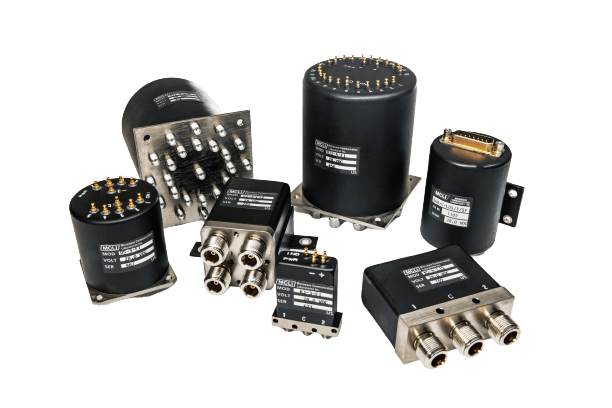
Electromechanical RF switches route microwave signals through different transmission paths by using a solenoid-driven mechanical contact to make or break the electrical path between ports. Because the signal passes through a metal-to-metal contact rather than a semiconductor junction, electromechanical switches deliver lower insertion loss, higher power handling, and better isolation than solid-state alternatives at equivalent frequencies. These characteristics make them the preferred choice wherever signal integrity and high power matter more than switching speed.
High Switch Cycle Reliability
Solid Build Construction
Many Available Configurations
Browse by category
Browse all Electromechanical Switches
Filters
Actuator
Frequency Range (GHz)
Insertion Loss (dB)
Isolation (dB)
VDC
VDC COM
CURRENT (mA) Max
Showing 121–132 of 451 results
| Part # | Actuator | Frequency Range (GHz) | Insertion Loss (dB) | Isolation (dB) | VDC | VDC Com | Current (Ma) Max | Lead Time | Notes | Action |
|---|---|---|---|---|---|---|---|---|---|---|
| D4-2-FI | FAILSAFE | DC-2.0 | 0.2 | 90 | 28 | (–) | 275 | 6-8 Weeks | N/A | Request Quote |
| D4-2-FIS | FAILSAFE | DC-2.0 | 0.2 | 90 | 28 | (–) | 275 | 6-8 Weeks | N/A | Request Quote |
| D4-2-LIL | LATCHING | DC-2.0 | 0.2 | 90 | 28 | (–) | 450 | 6-8 Weeks | N/A | Request Quote |
| D4-2-LLIS | LATCHING | DC-2.0 | 0.2 | 90 | 28 | (–) | 450 | 6-8 Weeks | N/A | Request Quote |
| D4-3-L | LATCHING | DC-2.5 | 0.25 | 80 | 28 | (–) | 450 | 6-8 Weeks | N/A | Request Quote |
| D4-4-L | LATCHING | DC-6.0 | 0.4 | 70 | 28 | (–) | 450 | 6-8 Weeks | N/A | Request Quote |
| D5-2-L/28P | LATCHING | DC-2.0 | 0.2 | 90 | 28 | (+) | 575 | 6-8 Weeks | N/A | Request Quote |
| D5-2-LIL | LATCHING | DC-2.0 | 0.2 | 90 | 28 | (–) | 685 | 6-8 Weeks | N/A | Request Quote |
| D5-2-LIS/28P | LATCHING | DC-2.0 | 0.2 | 90 | 28 | (+) | 575 | 6-8 Weeks | N/A | Request Quote |
| D5-LRL | LATCHING | DC-2.0 | 0.2 | 90 | 28 | (+) | 575 | 6-8 Weeks | N/A | Request Quote |
| D6-1-LIL | LATCHING | DC-1.0 | 0.2 | 90 | 12 | (–) | 680 | 6-8 Weeks | N/A | Request Quote |
| D6-1-LL | LATCHING | DC-1.0 | 0.2 | 90 | 28 | (–) | 685 | 6-8 Weeks | N/A | Request Quote |
Full Product Line Specifications
| Parameter | Range / Options |
|---|---|
| Frequency Range | DC to 26.5 GHz |
| Switch Configurations | SPDT, SP3T, SP4T, SP5T, SP6T |
| Actuator Type | Electromechanical solenoid |
| Actuator Voltage | 28 Vdc (+/- 3.0 Vdc) |
| Power Handling | Up to 200 W CW at 1.0 GHz |
| Impedance | 50 Ohms |
| Actuation Modes | Failsafe, latching, momentary |
| Port Termination | Terminated (open ports internally loaded) and non-terminated models available |
| Connector Type | SMA Female standard; other options available on request |
| Series Available | A Series (SP3T to SP6T, latching/failsafe/momentary), O Series (SP3T to SP6T), V Series (SP3T to SP6T, open ports terminated), K Series |
| Custom Options | Connector type, package configuration, actuator voltage, special mechanical requirements |
Where MCLI Electromechanical Switches Are Used
Automated Test and Measurement
Insertion loss repeatability across switching cycles is a defining specification for test applications because accumulated variation in loss degrades calibration accuracy over time. MCLI’s electromechanical construction delivers the mechanical contact stability that maintains repeatable insertion loss across thousands of switching cycles.
Radar and Defense Signal Routing
The 200 W power handling capability of MCLI’s switch line covers the continuous wave power levels present in many radar transmitter feed paths, and the 28 Vdc actuator voltage matches standard avionics and ground system power supply rails. Defense signal routing applications also benefit from the inherently low intermodulation distortion of a metal contact switch compared to PIN diode or FET-based solid-state alternatives.
Redundancy and Failover Switching
A latching switch holds its last commanded position without continuous actuator power, which reduces heat generation and power consumption in systems where the switch position changes infrequently. MCLI offers both actuation modes across the standard switch line.
Actuation Mode Selection Guide
| Mode | Behavior on Power Loss | Continuous Power Required | Best For |
|---|---|---|---|
| Failsafe | Returns to default position | No | Systems requiring a defined safe state during power interruption |
| Latching | Holds last commanded position | No | Low duty cycle switching, power-sensitive systems |
| Momentary | Returns to default when signal removed | Yes (to hold position) | Applications requiring frequent switching with active hold |