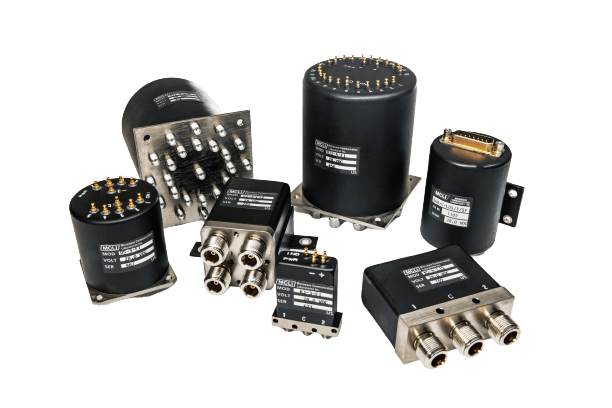
Electromechanical Switches

Signal Routing Switches from DC to 26.5 GHz for Test, Defense, and Communications Systems

Electromechanical RF switches route microwave signals through different transmission paths by using a solenoid-driven mechanical contact to make or break the electrical path between ports. Because the signal passes through a metal-to-metal contact rather than a semiconductor junction, electromechanical switches deliver lower insertion loss, higher power handling, and better isolation than solid-state alternatives at equivalent frequencies. These characteristics make them the preferred choice wherever signal integrity and high power matter more than switching speed.

A

High Switch Cycle Reliability

A

Solid Build Construction

A

Many Available Configurations

MCLI’s electromechanical switches are built for reliable service across applications ranging from single-instrument test bench setups to complex automated switch matrix systems. The line covers DC to 26.5 GHz and includes multiport configurations from SPDT through SP6T, in both terminated and non-terminated versions, with actuator voltage at 28 Vdc and power handling up to 200 watts CW at 1.0 GHz.

Browse all Electromechanical Switches

Filters


Actuator

Frequency Range (GHz)

Insertion Loss (dB)

Isolation (dB)

VDC

VDC COM

CURRENT (mA) Max

Showing 385–396 of 451 results

Part #ActuatorFrequency Range (GHz)Insertion Loss (dB)Isolation (dB)VDCVDC ComCurrent (Ma) MaxLead TimeNotesAction
O6-1-LILS LATCHINGDC-1.00.29028(–)6006-8 WeeksN/A Request Quote
O6-2-LI/12 LATCHINGDC-2.00.29012(–)2506-8 WeeksN/A Request Quote
O6-3-LIL LATCHINGDC-4.00.258028(–)6006-8 WeeksN/A Request Quote
O6-3-LL LATCHINGDC-4.00.258028(–)6006-8 WeeksN/A Request Quote
O6-3-LS LATCHINGDC-4.00.258028(–)6006-8 WeeksN/A Request Quote
O6-6-L/28N/LPM LATCHINGDC-12.40.47028(–)6006-8 WeeksN/A Request Quote
O6-7-L LATCHINGDC-18.00.56028(–)6006-8 WeeksN/A Request Quote
O6-7-L/28P LATCHINGDC-18.00.56028(+)6006-8 WeeksN/A Request Quote
O6-7-LI LATCHINGDC-18.00.56028(–)6006-8 WeeksN/A Request Quote
O6-7-LI/28P LATCHINGDC-18.00.56028(+)6006-8 WeeksN/A Request Quote
O6-7-LI/28P/LPM/C LATCHINGDC-13.00.56028(+)6006-8 WeeksN/A Request Quote
O6-7-LIS LATCHINGDC-18.00.56028(–)6006-8 WeeksN/A Request Quote

Full Product Line Specifications

Parameter Range / Options
Frequency Range DC to 26.5 GHz
Switch Configurations SPDT, SP3T, SP4T, SP5T, SP6T
Actuator Type Electromechanical solenoid
Actuator Voltage 28 Vdc (+/- 3.0 Vdc)
Power Handling Up to 200 W CW at 1.0 GHz
Impedance 50 Ohms
Actuation Modes Failsafe, latching, momentary
Port Termination Terminated (open ports internally loaded) and non-terminated models available
Connector Type SMA Female standard; other options available on request
Series Available A Series (SP3T to SP6T, latching/failsafe/momentary), O Series (SP3T to SP6T), V Series (SP3T to SP6T, open ports terminated), K Series
Custom Options Connector type, package configuration, actuator voltage, special mechanical requirements

Where MCLI Electromechanical Switches Are Used

Automated Test and Measurement

Switch matrices built from SP4T and SP6T units connect a single instrument to multiple devices under test without manual cable changes. Each switch position presents the same impedance and insertion loss to the signal path, so measurement results from port to port are consistent.

Insertion loss repeatability across switching cycles is a defining specification for test applications because accumulated variation in loss degrades calibration accuracy over time. MCLI’s electromechanical construction delivers the mechanical contact stability that maintains repeatable insertion loss across thousands of switching cycles.

Radar and Defense Signal Routing

Ground-based and airborne radar systems use electromechanical switches to route signals between transmit and receive chains, between redundant subsystems, or between different antenna feed paths.
The 200 W power handling capability of MCLI’s switch line covers the continuous wave power levels present in many radar transmitter feed paths, and the 28 Vdc actuator voltage matches standard avionics and ground system power supply rails. Defense signal routing applications also benefit from the inherently low intermodulation distortion of a metal contact switch compared to PIN diode or FET-based solid-state alternatives.

Redundancy and Failover Switching

Systems that cannot tolerate unplanned downtime use latching or failsafe switches to route signals around failed components. A failsafe switch returns to a known default position when power is removed, ensuring the signal path falls to a defined state during a power loss event.

A latching switch holds its last commanded position without continuous actuator power, which reduces heat generation and power consumption in systems where the switch position changes infrequently. MCLI offers both actuation modes across the standard switch line.

Actuation Mode Selection Guide

Mode Behavior on Power Loss Continuous Power Required Best For
Failsafe Returns to default position No Systems requiring a defined safe state during power interruption
Latching Holds last commanded position No Low duty cycle switching, power-sensitive systems
Momentary Returns to default when signal removed Yes (to hold position) Applications requiring frequent switching with active hold

Terminated vs. Non-Terminated Switches

A terminated switch routes internally generated loads, typically 50 ohm resistors, to the unused output ports when those ports are not in the active signal path. This keeps the input port impedance constant regardless of which output is selected, because each open port presents a matched load rather than an open circuit to the switch junction. A non-terminated switch leaves the unused output ports open. Non-terminated designs are appropriate when all output ports connect to matched loads externally, which is the case in most switch matrix configurations. When unused ports may be left unconnected, a terminated switch protects against the impedance irregularities and potential isolation degradation that open ports can introduce. MCLI offers both options in the V Series (terminated, open ports loaded) and standard A and O Series (non-terminated).

Frequently Asked Questions: Electromechanical RF Switchess

What Is the Difference Between a Latching and a Failsafe Electromechanical Switch?

Both modes describe what happens when actuator power is removed. A failsafe switch returns to a predetermined default port position, typically the first throw, whenever power is interrupted. This ensures the system falls to a known signal routing state during a power failure. A latching switch retains its last commanded position when power is removed. No continuous power is needed to hold the switch in place, which is useful in systems where the switch is positioned infrequently and holding current would generate unwanted heat. Choose failsafe when a defined default routing state is required for safety or system protection; choose latching when power efficiency and position retention matter.

What Is Insertion Loss Repeatability and Why Does It Matter in Test Systems?

Insertion loss repeatability is the variation in insertion loss from one switching cycle to the next. In a calibrated test system, the switch’s contribution to measured insertion loss is calibrated out at a known switch position. If the switch’s actual insertion loss changes slightly between cycles, that variation appears as measurement error in the results. Electromechanical switches achieve superior insertion loss repeatability compared to solid-state switches because the metal contact geometry is consistent from cycle to cycle. For automated test systems running thousands of switching cycles across a measurement campaign, this repeatability directly affects measurement accuracy and calibration validity.

What Does SP3T or SP6T Mean, and How Do I Choose the Right Configuration?

SPNT notation describes the switch topology. SP stands for single pole, meaning one common input port. The number indicates how many throw positions, or output ports, the common port can be connected to. An SP3T switch routes one input to any one of three outputs. An SP6T routes one input to any one of six outputs. Choose your configuration based on how many signal paths your system needs to address from a single common port. If your system has more paths than any single switch can address, multiple switches can be combined in a matrix to increase the number of addressable paths.

What Is Hot Switching and Can MCLI's Electromechanical Switches Handle It?

Hot switching means switching the RF signal path while RF power is present on the ports, rather than removing the RF signal before actuating the switch. Hot switching generates arcing at the contact surfaces, which accelerates contact wear and degrades insertion loss repeatability over the switch’s life. Electromechanical switches are generally rated for a defined number of hot switching cycles that is lower than their cold switching cycle life. For applications that require frequent hot switching, contact MCLI engineering to confirm the appropriate switch series and discuss expected cycle life under your specific power and frequency conditions.

How Does the 200 W Power Handling Rating Apply Across Frequency?

The 200 W CW power handling rating applies at 1.0 GHz. At higher frequencies, power handling decreases because conductor and dielectric losses in the switch body increase, raising internal temperatures at a given input power level. Applications at frequencies above a few gigahertz should derate the power handling based on the specific frequency of operation. Connector power handling is also a limiting factor at high power levels. Contact MCLI engineering for power handling guidance at specific frequencies above the 1.0 GHz reference point.

Can MCLI Supply Switches in Custom Connector Types or Mechanical Packages?

Yes. Standard catalog models use SMA Female connectors, but MCLI can supply switches in other connector types and custom mechanical packages. Contact MCLI with your frequency range, configuration, power level, actuator voltage, and mechanical requirements to begin a custom inquiry.
Parts0
There are no products in the cart!
0