

Power Dividers/Combiners
MCLI offers power dividers and combiners that are highly reliable with exceptional specifications offering broadband frequency ranges, high isolation, low insertion loss, low VSWR, low and high power solutions and can utilize different material construction such as stripline, microstrip, and lumped element technology to support various requirements and applications.
Octave Band, Special Band, Multi Band and Ultra Wide-Band Models Available
Solid Build Construction for High Reliability
Many In-Stock Models and Custom Designs Available
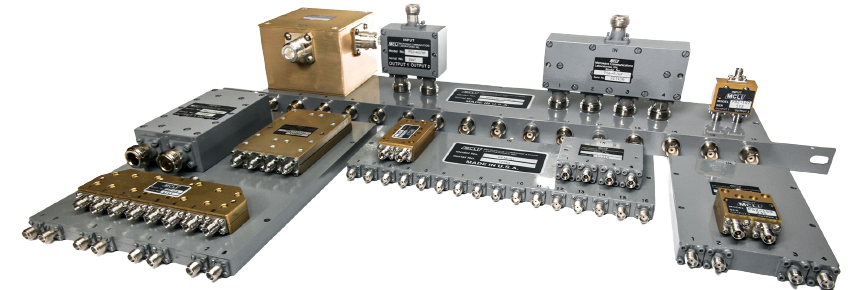
What separates a precision RF power divider from a simple resistive junction is how well it maintains impedance matching across all ports, minimizes excess insertion loss, and maximizes isolation between output ports. In systems where signal integrity and power budget matter, those numbers make a real difference.
MCLI has designed and manufactured power dividers and combiners for over 40 years, supplying defense prime contractors, satellite communications providers, research institutions, and commercial RF system integrators worldwide. Our catalog spans five construction technologies, covering applications from near-DC to 70 GHz and power levels from 1 watt to 10,000 watts.
Browse by Category
Browse all Power Dividers/Combiners
Filters
Connector Series
Insertion Loss (dB)
Isolation (dB)
VSWR In
VSWR Out
Amplitude Balance
Phase Balance
Power Average
Showing 1–50 of 1708 results
| Part # | Split Type | Frequency Range (GHz) | Insertion Loss (dB) | Isolation (dB) | VSWR | Amplitude Balance | Phase Balance | Power Avg. (W) | Lead Time | Notes | Action | ||
|---|---|---|---|---|---|---|---|---|---|---|---|---|---|
| Min | Max | In | Out | ||||||||||
| PR2-018 | N/A | DC | 18 | 2 | N/A | 1.40:1 | 1.40:1 | 0.3 | 3 | 1 | 3-4 Weeks | N/A | Request Quote |
| PR2-040 | N/A | DC | 40 | 2 | N/A | 1.70:1 | 1.70:1 | 0.25 | 2 | 1 | 3-4 Weeks | N/A | Request Quote |
| PR2-06/MI | N/A | DC | 6 | 0.5 | N/A | 1.25:1 | 1.25:1 | 0.3 | 3 | 1 | 3-4 Weeks | N/A | Request Quote |
| PR4-36 | N/A | DC | 6 | 14 | 12 | 1.60:1 | 1.60:1 | N/A | N/A | 1 | 5-6 Weeks | N/A | Request Quote |
| PR6-14 | N/A | DC | 6 | 15.5 | N/A | 1.50:1 | 1.50:1 | 1.5 | N/A | 1 | 5-6 Weeks | N/A | Request Quote |
| PR2-026 | N/A | DC | 26.5 | 7.8 | N/A | 1.50:1 | 1.50:1 | 0.5 | 5 | 1 | 5-6 Weeks | N/A | Request Quote |
| PR2-010 | N/A | DC | 10 | 6 | N/A | 1.40:1 | 1.40:1 | 0.7 | N/A | 1 | 5-6 Weeks | N/A | Request Quote |
| PR4-1 | N/A | DC | 18 | 15 | N/A | 1.80:1 | 1.80:1 | 0.3 | 4 | 1 | 5-6 Weeks | N/A | Request Quote |
| PR4-2 | N/A | DC | 40 | 16.8 | N/A | 2.00:1 | 2.00:1 | 1 | N/A | 1 | 5-6 Weeks | N/A | Request Quote |
| PR4-1/NF | N/A | DC | 18 | 15 | N/A | 1.50:1 | 1.50:1 | 1 | 8 | 1 | 5-6 Weeks | N/A | Request Quote |
| PR4-3 | N/A | DC | 10 | 12 | N/A | 1.50:1 | 1.50:1 | 1 | 8 | 1 | 5-6 Weeks | N/A | Request Quote |
| PR5-1 | N/A | DC | 6 | 14 | N/A | 1.35:1 | 1.35:1 | N/A | N/A | 1 | 5-6 Weeks | N/A | Request Quote |
| PR6-1 | N/A | DC | 10 | 16 | N/A | 1.50:1 | 1.50:1 | 0.6 | 6 | 1 | 5-6 Weeks | N/A | Request Quote |
| PR10-1 | N/A | DC | 10 | 20 | N/A | 1.65:1 | 1.65:1 | N/A | N/A | 1 | 5-6 Weeks | N/A | Request Quote |
| PR8-2 | N/A | DC | 10 | 18 | N/A | 1.60:1 | 1.60:1 | N/A | N/A | 1 | 5-6 Weeks | N/A | Request Quote |
| PR8-1 | N/A | DC | 3 | 19.5 | N/A | 1.35:1 | 1.35:1 | 1.5 | N/A | 1 | 5-6 Weeks | N/A | Request Quote |
| PR8-3 | N/A | DC | 18 | 19.5 | N/A | 1.80:1 | 1.80:1 | 1.5 | N/A | 1 | 5-6 Weeks | N/A | Request Quote |
| PR22-1/NF | N/A | DC | 1 | 27 | N/A | 1.40:1 | 1.40:1 | N/A | N/A | 1 | 6-8 Weeks | N/A | Request Quote |
| PR2-050 | N/A | DC | 50 | 2.5 | N/A | 1.65:1 | 1.65:1 | 0.6 | 6 | 1 | 5-6 Weeks | N/A | Request Quote |
| PL2-20 | 2-Way | 0.00001 | 0.1 | 1 | 20 | 1.30:1 | 1.30:1 | 0.2 | 2 | 1 | 5-6 Weeks | N/A | Request Quote |
| PL8-14 | 8-Way | 0.00001 | 0.03 | 1 | 25 | 1.30:1 | 1.30:1 | 0.2 | 3 | 1 | 5-6 Weeks | N/A | Request Quote |
| PL8-24 | 8-Way | 0.00001 | 0.1 | 1.6 | 23 | 1.40:1 | 1.40:1 | 0.6 | 8 | 1 | 5-6 Weeks | N/A | Request Quote |
| PL8-14/BNC | 8-Way | 0.00001 | 0.03 | 1 | 25 | 1.30:1 | 1.30:1 | 0.2 | 3 | 1 | 5-6 Weeks | N/A | Request Quote |
| PL16-10 | 16-Way | 0.00001 | 0.03 | 1.2 | 25 | 1.40:1 | 1.40:1 | 0.2 | 3 | 1 | 6-8 Weeks | N/A | Request Quote |
| PL16-10/NF | 16-Way | 0.00001 | 0.03 | 1.2 | 25 | 1.40:1 | 1.40:1 | 0.2 | 3 | 1 | 6-8 Weeks | N/A | Request Quote |
| PL32-10 | 32-Way | 0.00001 | 0.03 | 1.5 | 22 | 1.50:1 | 1.50:1 | 0.3 | 5 | 1 | 6-8 Weeks | N/A | Request Quote |
| PLH2-33 | 2-Way | 0.00001 | 0.25 | 1.5 | 18 | 1.40:1 | 1.40:1 | 0.6 | 8 | 100 | 9-10 Weeks | N/A | Request Quote |
| PLH2-55 | 2-Way | 0.00001 | 0.4 | 0.6 | 15 | 1.50:1 | 1.50:1 | 0.35 | 8 | 100 | 9-10 Weeks | N/A | Request Quote |
| PLH4-20 | 4-Way | 0.00001 | 0.22 | 1.7 | 20 | 1.35:1 | 1.35:1 | 0.75 | 8 | 300 | 9-10 Weeks | N/A | Request Quote |
| PL4-32 | 4-Way | 1.0E-5 | 0.06 | 0.8 | 20 | 1.30:1 | 1.30:1 | 0.2 | 2 | 1 | 5-6 Weeks | N/A | Request Quote |
| PL4-32/NF | 4-Way | 1.0E-5 | 0.06 | 0.8 | 20 | 1.30:1 | 1.30:1 | 0.2 | 2 | 1 | 5-6 Weeks | N/A | Request Quote |
| PL32-11 | 32-Way | 0.00005 | 0.1 | 1.6 | 20 | 1.50:1 | 1.50:1 | 0.5 | 9 | 1 | 6-8 Weeks | N/A | Request Quote |
| PL2-15 | 2-Way | 0.0001 | 0.4 | 0.8 | 25 | 1.30:1 | 1.30:1 | 0.3 | 2 | 1 | 5-6 Weeks | N/A | Request Quote |
| PL4-36/NF | 4-Way | 0.0001 | 0.032 | 0.4 | 4 | 1.20:1 | 1.20:1 | 0.15 | 1 | 2 | 5-6 Weeks | N/A | Request Quote |
| PL8-1-75/BF | 8-Way | 0.0001 | 0.1 | 1.6 | 23 | 1.40:1 | 1.40:1 | 0.6 | 3 | 1 | 5-6 Weeks | N/A | Request Quote |
| PL8-1/BNC | 8-Way | 0.0001 | 0.1 | 1.6 | 23 | 1.40:1 | 1.40:1 | 0.6 | 3 | 1 | 5-6 Weeks | N/A | Request Quote |
| PL8-1/NF | 8-Way | 0.0001 | 0.1 | 1.6 | 23 | 1.40:1 | 1.40:1 | 0.6 | 3 | 1 | 5-6 Weeks | N/A | Request Quote |
| PL8-1/NFI | 8-Way | 0.0001 | 0.1 | 1.6 | 23 | 1.40:1 | 1.40:1 | 0.6 | 3 | 1 | 5-6 Weeks | N/A | Request Quote |
| PLH2-34 | 2-Way | 0.0001 | 0.02 | 0.2 | 20 | 1.20:1 | 1.20:1 | 0.1 | 5 | 400 | 9-10 Weeks | N/A | Request Quote |
| PLH2-35 | 2-Way | 0.0001 | 0.25 | 0.6 | 15 | 1.35:1 | 1.35:1 | 0.3 | 5 | 100 | 9-10 Weeks | N/A | Request Quote |
| PLH4-40 | 4-Way | 0.0001 | 0.015 | 0.3 | 20 | 1.30:1 | 1.30:1 | 0.15 | 5 | 100 | 9-10 Weeks | N/A | Request Quote |
| PLH4-21 | 4-Way | 0.0001 | 0.03 | 0.4 | 20 | 1.30:1 | 1.30:1 | 0.2 | 5 | 400 | 9-10 Weeks | N/A | Request Quote |
| PL3-12/BF | 3-Way | 0.0002 | 0.8 | 1.1 | 23 | 1.30:1 | 1.30:1 | 0.3 | 3 | 1 | 5-6 Weeks | N/A | Request Quote |
| PL3-32 | 3-Way | 0.0002 | 0.02 | 0.3 | 25 | 1.20:1 | 1.20:1 | 0.2 | 2 | 1 | 5-6 Weeks | N/A | Request Quote |
| PL2-24 | 2-Way | 0.00025 | 0.0005 | 0.2 | 22 | 1.20:1 | 1.20:1 | 0.2 | 2 | 30 | 5-6 Weeks | N/A | Request Quote |
| PL2-24/TNC | 2-Way | 0.00025 | 0.0005 | 0.2 | 22 | 1.20:1 | 1.20:1 | 0.2 | 2 | 30 | 5-6 Weeks | N/A | Request Quote |
| PL2-1 | 2-Way | 0.0003 | 0.06 | 0.5 | 35 | 1.30:1 | 1.30:1 | 0.2 | 1 | 1 | 1-2 Weeks | N/A | Request Quote |
| PL2-1-75/BF | 2-Way | 0.0003 | 0.06 | 0.5 | 35 | 1.30:1 | 1.30:1 | 0.2 | 1 | 1 | 1-2 Weeks | N/A | Request Quote |
| PL2-1/NF | 2-Way | 0.0003 | 0.06 | 0.5 | 33 | 1.30:1 | 1.30:1 | 0.2 | 1 | 1 | 1-2 Weeks | N/A | Request Quote |
| PL2-1/PE | 2-Way | 0.0003 | 0.06 | 0.5 | 33 | 1.30:1 | 1.30:1 | 0.2 | 1 | 1 | 1-2 Weeks | N/A | Request Quote |
Full Product Line Specifications: Frequency, Power, and Electrical Performance
The following ranges represent the full span of MCLI’s power divider and combiner product line. Each subcategory page provides specifications specific to that construction technology.
| Parameter | Range / Options |
|---|---|
| Frequency Range | DC / 0.00001 GHz to 70.0 GHz |
| Split Configurations | 2-way, 3-way, 4-way, 5-way, 6-way, 8-way, 10-way, 12-way, 16-way, 22-way, 32-way |
| Power Handling | 1 W to 10,000 W average (construction-dependent) |
| Insertion Loss | As low as 0.1 dB excess loss above theoretical split loss |
| Port-to-Port Isolation | Typically 10 dB to 60 dB depending on topology and frequency band |
| Input / Output VSWR | As low as 1.20:1 on both input and output ports |
| Return Loss | Up to 28 dB on select models |
| Amplitude Balance | As tight as +/-0.1 dB across rated bandwidth |
| Phase Balance | As tight as +/-1 degree across rated bandwidth |
| Characteristic Impedance | 50 ohm standard; 75 ohm models available |
| Construction Technologies | Stripline, Microstrip, Lumped Element, High Power Lumped Element, Resistive |
| Connector Options | SMA, Type N, BNC, TNC, 2.92mm (K), 2.4mm, 1.85mm (V), 7/16 DIN, Type F, LC, SC, Surface Mount, Pin |
| Frequency Coverage | Octave band, special band, multi-band, and ultra-wideband models available |
| Custom Design | Available. Contact MCLI engineering for non-standard requirements. |
Where MCLI Power Dividers and Combiners Are Used
Phased Array Radar and Electronic Warfare Systems
RF Test Bench Signal Distribution and VNA Reference Paths
High-Power Amplifier Combining Networks for Satcom
Cellular Base Station and Distributed Antenna Systems
Research and Prototype RF Systems
Construction Technology and Topology Guide
Selecting the right power divider starts with frequency range and power handling, then narrows by construction topology.
Wilkinson-based designs (stripline and microstrip) deliver low insertion loss and high port isolation by using quarter-wave transmission line sections and isolation resistors between output ports.
Lumped element designs replace those transmission line sections with discrete inductors and capacitors, enabling coverage down to near-DC in a compact form factor.
Resistive designs use purely resistive networks, trading isolation and insertion loss efficiency for the broadest possible bandwidth.
| Series / Technology | Topology | Frequency Range | Power Range | Best For | Key Trade-off |
|---|---|---|---|---|---|
| Stripline (PS Series) | Wilkinson | 0.1 to 70 GHz | 2 to 80 W | Defense, phased array, high-frequency signal distribution | Larger form factor vs. microstrip |
| Microstrip (PM Series) | Wilkinson | 0.15 to 2.7 GHz | 1 to 200 W | Cellular base station, commercial RF | Narrower frequency range |
| Lumped Element (PL Series) | Lumped LC | DC to 3.7 GHz | 1 W | Lab use, low-power signal distribution, near-DC applications | Not suited for high power |
| High Power Lumped Element (PLH Series) | Lumped LC | DC to 5.0 GHz | 5 to 10,000 W | High-power amplifier combining, satcom ground systems | Lower upper frequency limit |
| Resistive (PR Series) | Resistive | DC to 40 GHz | 1 W | VNA reference paths, broadband test and measurement | Inherent 6 dB loss above theoretical split |