

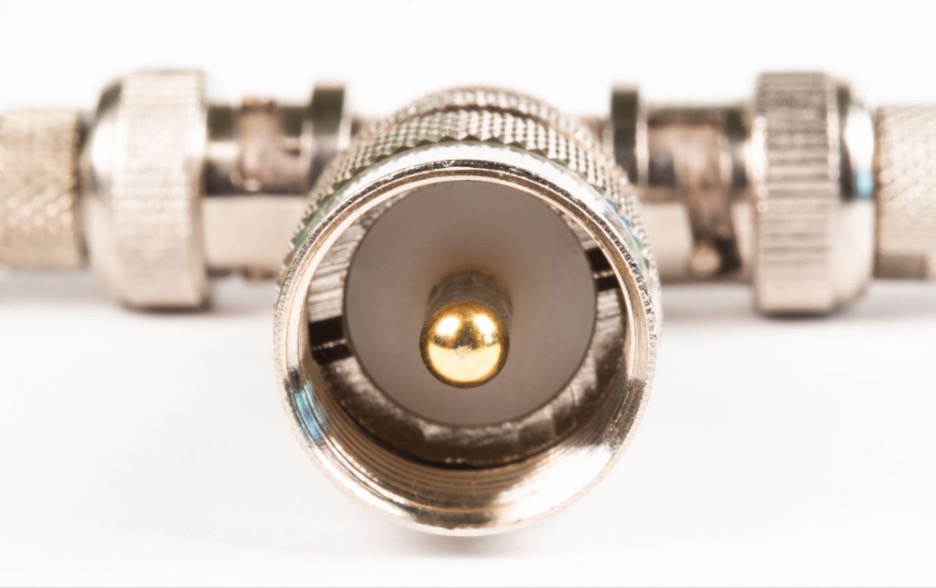
Defense subcontractors integrating subsystems for a prime program face a recurring question: how do you measure or sample an RF signal without disturbing the path it sits on? Whether you’re integrating a transmit chain, building a test set, or designing a monitoring subsystem, you need a way to see what the signal is doing in real time.
So what is a directional coupler? It’s a four-port passive device that samples a signal traveling in one direction on a transmission line while ignoring signals going the other way. Most of the power passes through. A small, predictable fraction is split off for measurement.
This post explains how directional couplers work, what the main configurations do, and how to match the right type to a defense integration task. Whether you’re spec’ing parts for an SOW or troubleshooting a subsystem, the goal here is to help you make the right call without wasting program time.
How a Directional Coupler Works
A directional coupler has four ports. Each one does a specific job, and how they relate to each other is what makes the device useful for RF integration work.
- Input port: where the signal enters from the source (often a power amplifier or transmitter).
- Output port: where most of the signal exits to the load (often an antenna or test load).
- Coupled port: where a small, controlled fraction of the signal is sampled for measurement or feedback.
- Isolated port: stays quiet unless reflected energy comes back from the load.
The forward signal flows from input to output with very little loss. A small, known fraction couples to the coupled port. Reflected signals (if any) go to the isolated port instead, which is how you separate forward and reverse power measurements.
This separation is what makes directional couplers different from a basic power splitter. A splitter divides power without regard to direction. A directional coupler sorts forward and reverse signals into different ports, which is what lets you measure forward power and reflected power independently.
The Specs That Drive Coupler Selection
Three specs do most of the work when picking a coupler for a defense subsystem. Reading them correctly is the difference between an integration that works the first time and one that fights you through bring-up.
Coupling Factor
Coupling factor tells you how much of the forward signal appears at the coupled port, measured in dB. A 20 dB coupler delivers 1/100th of the input power to the coupled port.
A 10 dB coupler delivers 1/10th. Lower coupling factor (larger number) means a smaller sample. Higher coupling factor (smaller number) means a larger sample but more insertion loss on the main line.
Directivity
Directivity is the spec that defines how cleanly the coupler separates forward from reverse signals. It’s measured in dB and represents the difference between the wanted signal at the coupled port and the leakage from the reverse direction.
A coupler with 20 dB directivity is acceptable for general monitoring. Higher directivity (25 dB or better) gives more accurate forward-power and reflected-power measurements.
That accuracy matters when you’re using the coupler to drive a VSWR (voltage standing wave ratio) calculation or close a feedback loop.
Insertion Loss
Insertion loss is how much main-line signal is lost passing through the coupler. Lower is better. Quality couplers deliver under 0.5 dB across their operating bandwidth.
Insertion loss matters most in transmit chains where every dB of loss means less power at the antenna. In receive chains and test setups, the budget is usually more forgiving.
Common Directional Coupler Configurations
Three configurations cover most defense subsystem integration tasks. Picking between them depends on what you need to measure and where the coupler sits in the signal chain.
Each configuration trades off complexity, cost, and what kind of data the coupler gives you. The simplest option works fine for monitoring tasks. Precision measurement work usually calls for one of the more capable types.
Uni-Directional Couplers
Uni-directional couplers have a single coupled port and a single isolated port (often internally terminated).
They sample signal flow in one direction only. These are the simplest configuration and the most common choice for forward power monitoring in transmit chains where you don’t need reverse-power data.
Bi-Directional Couplers
Bi-directional couplers have two coupled ports, one for forward and one for reverse. They give you simultaneous access to both directions on the same line.
These are common in integration test setups where you need to characterize both transmitted and reflected power during bring-up. Subsystems that drive automatic VSWR shutdown logic often rely on the same configuration.
Because both ports are available at the same time, you don’t have to reroute connectors or run multiple sweeps to capture forward and reverse data.
Dual-Directional Couplers
Dual-directional couplers also provide separate forward and reverse coupled ports, but typically with tighter directivity specs and matched coupling factors between the two paths.
Defense integrators often choose dual-directional models for precision measurement tasks. Production test, calibration setups, and built-in test (BIT) circuits all fall into this category.
In those tasks, measurement accuracy directly affects qualification results, which makes the tighter directivity spec worth the cost difference.
How to Match a Coupler to Your Integration Task
Selection should start from the task, not from a catalog default. Three questions get you to the right part most of the time.
First, what are you trying to measure? Forward power only points to a uni-directional model. Forward and reverse together points to bi-directional or dual-directional, with dual-directional preferred when measurement accuracy matters.
Second, what’s the power level? Average and peak both matter, especially in pulsed radar test setups where peak power can run far higher than average. Pick a coupler whose ratings cover your worst-case condition with margin.
Third, what’s the frequency range? Make sure the coupler holds flat coupling and consistent directivity across your whole operating band, not just the center frequency.
Wideband programs need broadband models that maintain spec across multiple octaves.
For a wider view of how RF measurement traceability fits into defense test workflows, the National Institute of Standards and Technology (NIST) guided wave metrology program publishes research on microwave power, scattering parameters, and calibration that many defense subcontractors reference during qualification work.
Picking the Right Coupler for Your Subsystem
Directional couplers are one of the most common building blocks in defense RF integration work. Knowing what each configuration does, and how the three main specs interact, makes selection straightforward.
For subcontractors working against tight program schedules, picking the right coupler the first time avoids rework, requalification, and missed delivery dates. A small spec mismatch on a coupler can cascade into bigger problems downstream.
MCLI manufactures directional couplers from DC through 65 GHz in uni-directional, bi-directional, and dual-directional configurations. Many models ship same-day from stock for fast integration timelines.
Need help matching a coupler to your subsystem requirements? Contact us for a quote.