

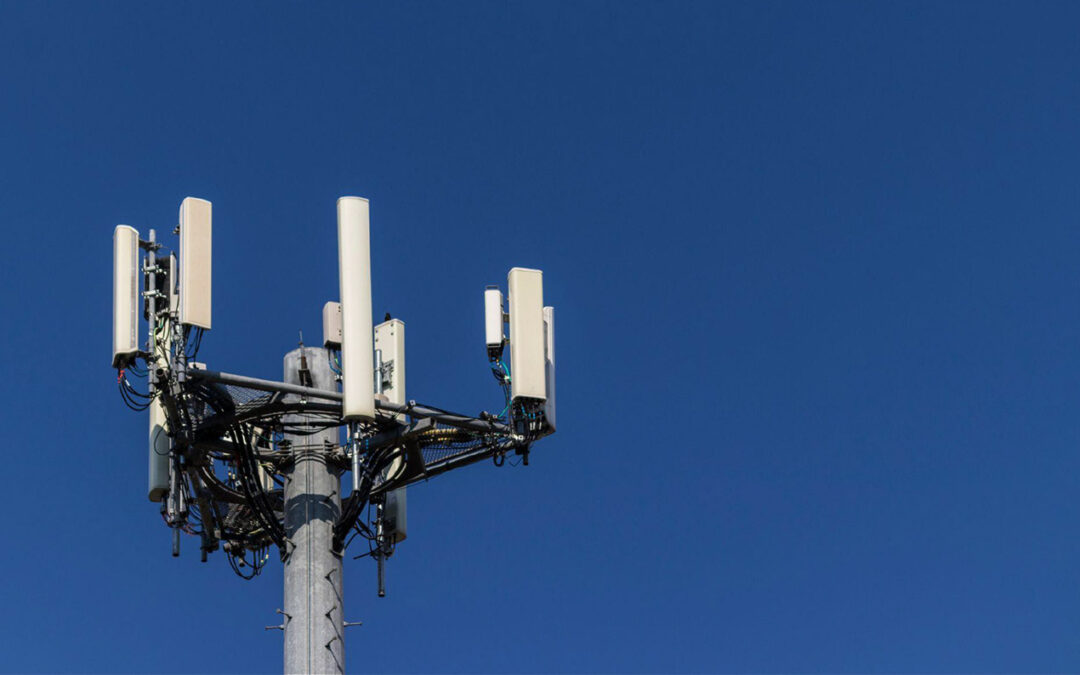
Every generation of cellular technology adds pressure at the radio layer, and 5G base station architecture raises that pressure sharply: more antennas per site, more frequency bands, higher operating frequencies, and far more RF content packed into each radio than any earlier generation carried. The digital and software layers get most of the attention, but coverage, capacity, and signal quality are ultimately decided by the analog hardware that generates and shapes the signal. This article stays in that layer. It covers the RF front end and the passive components inside the radio unit, written for the engineers who specify that hardware rather than the teams managing network software. MCLI supplies the precision RF components that this part of the network depends on.
The Base Station, From Baseband to Antenna
A modern base station separates into processing and radio functions. The processing side handles the digital work, and in current deployments it often splits into a centralized unit and a distributed unit that manage the protocol and scheduling layers. The radio unit sits closest to the antenna and is where the signal becomes RF: generated, amplified, filtered, and routed to an array of antenna elements. That radio unit is this article’s territory. It is the part of the radio access network where passive RF components do their work, and where the quality of those components shows up directly in network performance.
Naming the processing split matters only for orientation. Once the signal reaches the radio unit, the story is entirely analog, and the components covered below are the ones that determine how faithfully that signal reaches the antenna and the user.
The RF Front End Sets the Performance Ceiling
Whatever the digital layers accomplish, the analog front end sets the limit they operate within. The RF front end comprises the transceiver that converts baseband signals to the transmitted band, the power amplifier that provides the gain a cell needs for coverage, the low-noise amplifier that recovers weak signals on receive, and the filtering and passive network that condition and route everything in between. A weakness anywhere in that chain caps the performance of the whole radio.
5G tightens every one of those requirements. Higher frequencies, including mmWave bands, shrink wavelengths and raise the cost of every fraction of a decibel lost in the signal path. Wider bandwidths demand flatter, more consistent component behavior across frequency. Stricter linearity targets leave less room for distortion introduced anywhere in the front end. Those pressures are why component selection at this layer is an engineering decision rather than a commodity purchase. The passive parts that split, combine, and sample the signal have to hold their specifications across temperature, frequency, and years of continuous field operation.
Power Dividers Distribute Signal Across Antenna Paths

Massive MIMO is the defining feature of 5G radios, and it depends on distributing a signal across many antenna elements on transmit and combining contributions on receive. That distribution cannot be lossy or inconsistent. If the paths feeding the array differ in amplitude or phase, the beam degrades and the capacity gains that justify the array evaporate.
Power dividers and combiners handle this split-and-combine work. They take one signal and divide it across multiple ports with controlled, predictable loss and phase relationships, or perform the reverse on the receive side. In a base station feeding dozens of antenna elements, the consistency of those dividers across every path is what keeps the array coherent.
MCLI’s power dividers and combiners cover a wide range of frequencies and port configurations suited to infrastructure radios. The most common topology for this duty is the Wilkinson design, which delivers the low loss and high port-to-port isolation these systems require; our guide to the wilkinson power divider covers how the topology works and when to specify it.
Hybrids Enable Beamforming and Balanced Feeds
Beamforming is what turns a large antenna array into focused capacity. By applying controlled amplitude and phase shifts across the radiating elements, the array steers energy toward users and away from interference. Those phase relationships have to be created and maintained accurately, and 90 degree and 180 degree hybrids are core to that job.
Hybrids split or combine signals with precise phase offsets, which makes them essential building blocks in beamforming feed networks and in balanced amplifier configurations that improve linearity and reliability in the transmit chain. The accuracy of a hybrid’s phase and amplitude balance feeds directly into how cleanly the array can form and steer a beam.
MCLI’s 90 degree and 180 degree hybrids are available across the frequency ranges used in commercial wireless infrastructure, with the balance and isolation performance that beamforming networks demand.
Directional Couplers Support Power Monitoring and Calibration
A base station has to know what its amplifiers are doing at all times. Output power must stay within regulatory and design limits, amplifiers need protection from reflected power caused by antenna faults or mismatches, and the whole chain requires calibration during manufacture and periodic self-checks in the field. All of that depends on sampling the signal without disturbing it.
Directional couplers provide that sample. They tap a small, precisely known fraction of the forward and reflected power traveling along the transmission path, feeding monitoring and calibration circuits while the main signal continues to the antenna undisturbed. In a radio expected to run continuously for years, the stability and directivity of that coupler determine how trustworthy the power measurements remain over the life of the equipment.
MCLI’s directional couplers cover the coupling values and power levels used across infrastructure radios, in stock for both production and test applications.
Density and Deployment Scale Multiply Component Demand
5G does not only add components inside each radio. It adds radios across the landscape. Higher frequencies cover shorter distances, so networks densify with small cells to fill the coverage that fewer, taller towers once handled. Every small cell is another radio unit with its own front end, its own dividers, hybrids, and couplers.
The result is a demand curve that climbs on two axes at once: more RF content per radio, and more radios per square mile. For anyone sourcing components into this market, that combination turns component availability from a routine procurement question into a factor that can pace an entire deployment program.
Supply Reliability Keeps Network Rollouts on Schedule
Infrastructure buildouts run on deployment schedules, and those schedules are unforgiving. A component on a long lead time does not delay a single board, it delays site activations and the revenue that follows them. An end-of-life notice on a qualified part can force requalification work that ripples across a program. In a market defined by scale and speed, the reliability of the supply chain is part of the design.
MCLI has manufactured precision passive and active RF components for over 40 years under an ISO 9001:2015 certified quality system. With deep standard inventory across power dividers, hybrids, and couplers, and same-day shipping on stocked parts, MCLI helps infrastructure programs keep components off the critical path. For a buildout measured in thousands of radios, availability is a specification.
FAQ
What are the main components of a 5G base station?
A base station divides into processing units that handle the digital and protocol work and a radio unit that handles the RF functions. The radio unit contains the front end: transceiver, power amplifier, low-noise amplifier, filtering, and the passive network of dividers, hybrids, and couplers that route and condition the signal on its way to the antenna array.
What is the RF front end in a 5G base station?
The RF front end is the analog section of the radio that converts baseband signals to the transmitted band and back, amplifies them, filters them, and routes them to the antenna. It sets the performance ceiling for coverage and signal quality, since no amount of digital processing can recover what a weak analog chain loses.
What is massive MIMO in 5G?
Massive MIMO uses a large array of antenna elements to serve multiple users at once in the same frequency resource, boosting capacity and throughput. It relies on distributing signals across many paths with consistent amplitude and phase, which is why low-loss power dividers and accurate hybrids matter to its performance.
What is the difference between a gNodeB and a base station?
gNodeB, often shortened to gNB, is simply the term the 5G standard uses for the base station. It refers to the same role, the equipment that connects user devices to the cellular network, described in 5G-specific terminology.
Source Precision RF Components for Wireless Infrastructure
MCLI stocks the power dividers, hybrids, and couplers that 5G radios depend on, backed by four decades of RF manufacturing and quick delivery on in-stock models. Request a quote to discuss components for your system.